Why Columbus Is Becoming a Hub for Small Business Marketing Innovation

In recent years, Columbus has quietly shifted from being a stable Midwest business city to a place where small businesses actively test, adapt, and refine modern marketing ideas faster than expected. One telling indicator is how often local startups and service-based businesses experiment with digital campaigns, brand messaging, and audience targeting at early stages, rather than waiting until later growth phases.
Columbus offers a unique mix of economic flexibility, access to emerging talent, and a market size that allows businesses to try new marketing approaches without the pressure found in larger coastal cities. This article explores why Columbus is increasingly recognized as a hub for small business marketing innovation and what factors are driving this shift at a local level.
Understanding Columbus’s Shift Toward Marketing-Driven Entrepreneurship
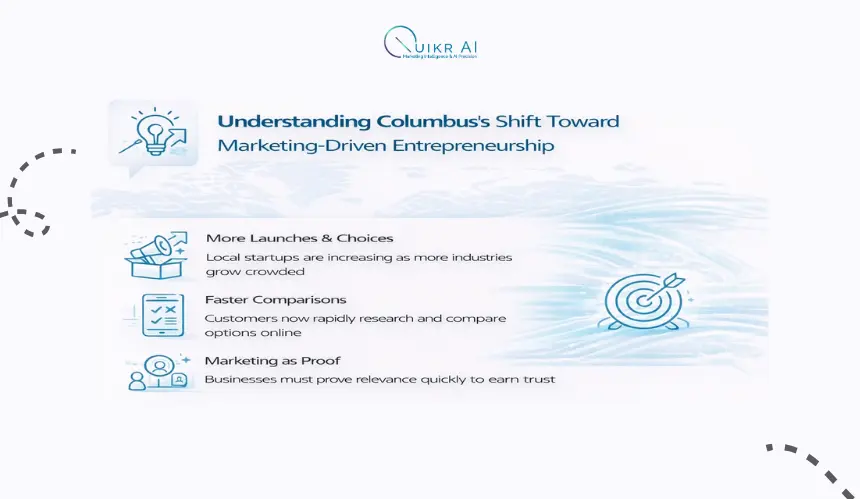
For years, many small businesses in Columbus could grow on reputation alone, especially in tight local circles where referrals carried real weight. That still matters, but the city’s pace has changed. More new brands are launching, more categories feel crowded, and customers compare options faster than they used to.
In that environment, marketing becomes less about “getting the word out” and more about proving relevance quickly.
How Has The Role Of Marketing Changed For Small Businesses?
Marketing is increasingly treated like a business system, not a side task. Local owners often build their online presence, positioning, and messaging early because they know visibility can decide who gets the first call, the first visit, or the first quote request.
Instead of relying on one channel, many businesses think in terms of discoverability across local search, social platforms, and review ecosystems, then adjust based on what customers actually respond to.
Did You Know? Columbus has attracted a major share of Ohio’s startup capital over the long run.
Axios Columbus reported that nearly half of Ohio’s startup capital since 2013 has been invested in Columbus, reflecting a maturing ecosystem where modern go-to-market thinking, including marketing strategy, becomes a serious competitive advantage.
Why Are Entrepreneurs Prioritizing Marketing Earlier In Their Growth Cycle?
Many Columbus entrepreneurs are building in a “prove it fast” environment. When multiple businesses offer similar services, early marketing helps clarify what makes one option feel more trustworthy, more specialized, or more aligned with the customer’s needs.
That urgency shows up in how founders talk about traction, leads, and retention, not as abstract metrics, but as survival signals. Marketing becomes the tool that turns a good offer into a clear choice, especially when attention is limited and competition is nearby.
What Makes Columbus Supportive Of Marketing-Led Business Models?
With over 900,000 residents in the city and more than 2 million people across the greater Columbus metro area, businesses are operating in a market that is large enough to generate consistent demand without feeling overcrowded.
Columbus supports marketing-led growth because this scale rewards iteration rather than brute-force spending. Small businesses can test campaigns, refine positioning, and adjust messaging without needing massive budgets just to stay visible.
That balance creates space for testing messaging, refining audiences, and learning what resonates locally. That learning curve feels empowering because small improvements show up in real outcomes like better inquiries, stronger repeat business, and clearer brand recognition.
Did You Know? Columbus was selected as the winner of the U.S. Department of Transportation’s Smart City Challenge, receiving up to $40 million in federal funding plus up to $10 million from Vulcan Inc., alongside significant local partner commitments.
While this was a transportation initiative, it’s also a signal of Columbus’s broader culture of measurable innovation and pilot-driven decision-making, which aligns with how modern marketing is tested and optimized.
Economic And Demographic Factors Fueling Marketing Experimentation in Columbus
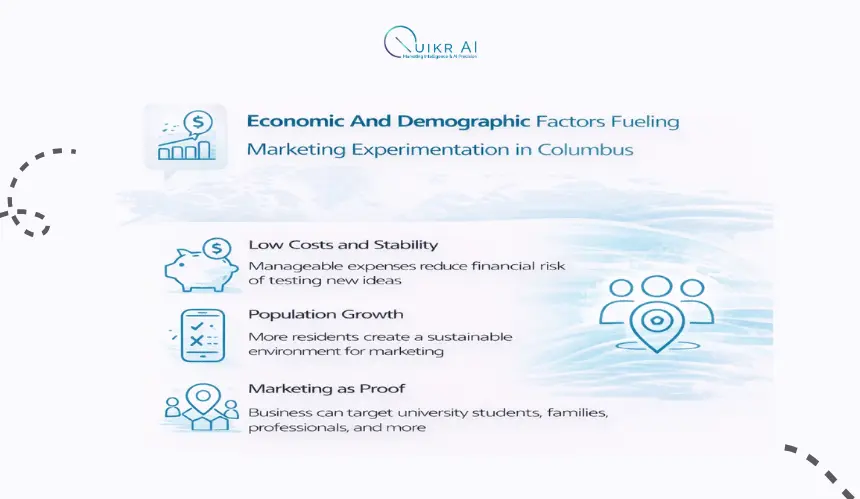
Columbus gives small businesses room to try new marketing ideas without the financial pressure common in larger metros.
Economic stability, steady population growth, and a diverse customer base combine to create conditions where experimentation feels practical rather than risky. These factors shape how marketing strategies are planned, tested, and improved at the local level.
How Do Cost Structures In Columbus Enable Faster Marketing Iteration?
Quick Fact: Columbus has a cost of living 6% below the national average, with housing 4% cheaper and healthcare 19% lower, aiding small businesses compared to pricier cities.
Rent,staffing, and overhead costs remain relatively manageable across many neighborhoods, which means owners can invest in campaign testing, creative updates, and channel experimentation without jeopardizing cash flow.
This flexibility encourages trial and adjustment instead of committing to one rigid strategy. As a result, marketing decisions become data-informed earlier, helping businesses refine their approach before scaling.
How Does Columbus’s Demographic Mix Influence Marketing Strategy Choices?
Columbus has one of the most diverse population profiles in Ohio, shaped by universities, healthcare systems, logistics employers, and a growing technology presence.
Quick Insight:Columbus has a more diverse population profile than many other Ohio cities, ranking around the middle nationally for non-White population share. The city is also strongly shaped by young professionals, with one of the top concentrations among U.S. metro areas.
This diversity pushes businesses to think beyond one-size-fits-all messaging. Local marketing often reflects multiple audience segments, including students, young professionals, families, and long-term residents.
Businesses that succeed here learn to tailor messaging, visuals, and channels to different groups, building stronger relevance and trust within specific pockets of the market.
The Role Of Local Talent And Skill Convergence
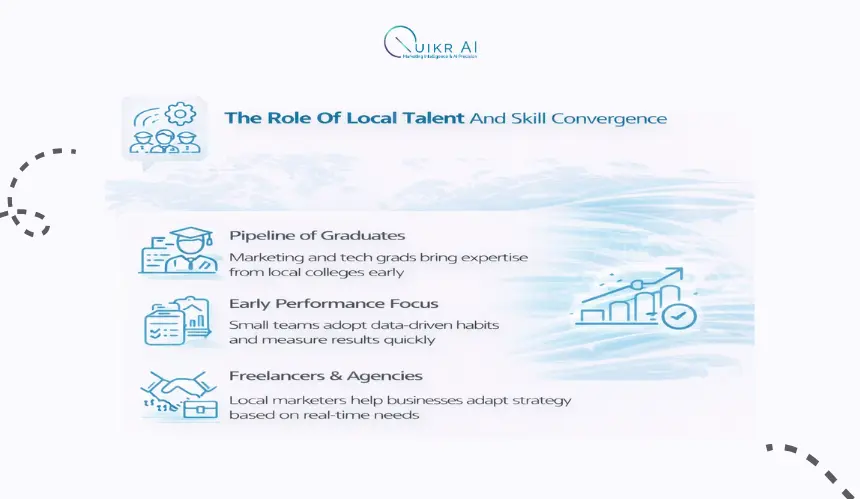
Marketing innovation in Columbus is not driven by tools alone. It is shaped by the people applying those tools with a practical mindset. What makes the city stand out is how different skill sets converge early inside small businesses, allowing strategy, execution, and analysis to evolve together instead of operating in silos.
How Do Universities And Workforce Pipelines Shape Marketing Skillsets In Columbus?
Columbus benefits from a steady pipeline of graduates entering marketing, data, design, and technology roles each year. Institutions like The Ohio State University and nearby colleges produce talent that is already familiar with analytics platforms, content systems, and customer research methods.
Many graduates step into small businesses rather than large enterprises, bringing structured thinking into lean teams. This early exposure helps local companies adopt performance-aware marketing habits sooner, such as tracking audience behavior, testing messaging, and refining conversion paths based on real feedback.
Fact: The market of Columbus is supported by nearly 22,000 college graduates entering the workforce each year. This millennial-heavy talent base influences how businesses communicate, pushing marketing strategies toward clarity, authenticity, and digitally fluent messaging that resonates with a younger, more varied audience.
How Do Freelancers And Local Agencies Accelerate Marketing Innovation Locally?
Columbus has a strong presence of independent marketers, consultants, and local agencies that work closely with small businesses across the city. These professionals often specialize in focused areas such as local search visibility, paid media optimization, and conversion-focused design, while collaborating across projects to keep strategies flexible and results-driven.
An SEO agency in Columbus can help small businesses strengthen local search presence, refine keyword targeting based on neighborhood-level demand, and improve on-page performance without requiring the scale or complexity of a large national firm.
Technology Adoption Patterns Among Columbus Small Businesses
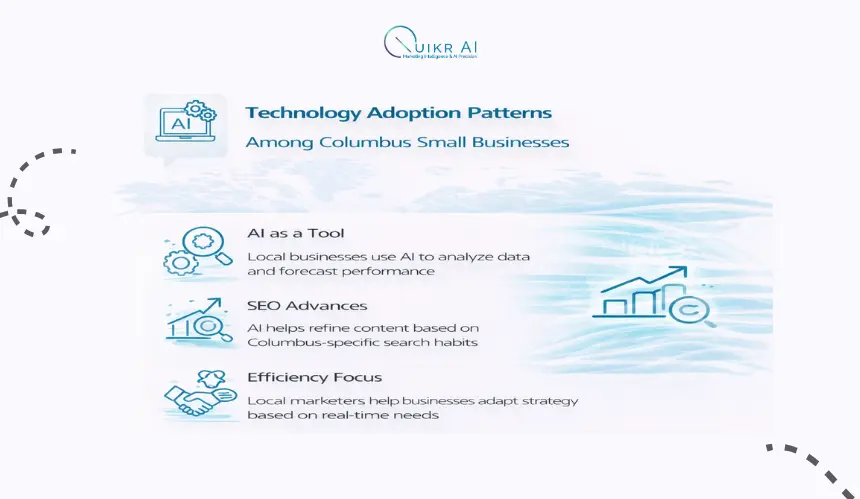
As marketing maturity increases across Columbus, artificial intelligence is becoming a practical extension of how small businesses plan, test, and refine their visibility strategies. Rather than treating AI as a disruptive trend, local businesses are adopting it selectively to support clearer decisions, faster analysis, and more predictable outcomes.
How Are Small Businesses Applying AI To Marketing Workflows?
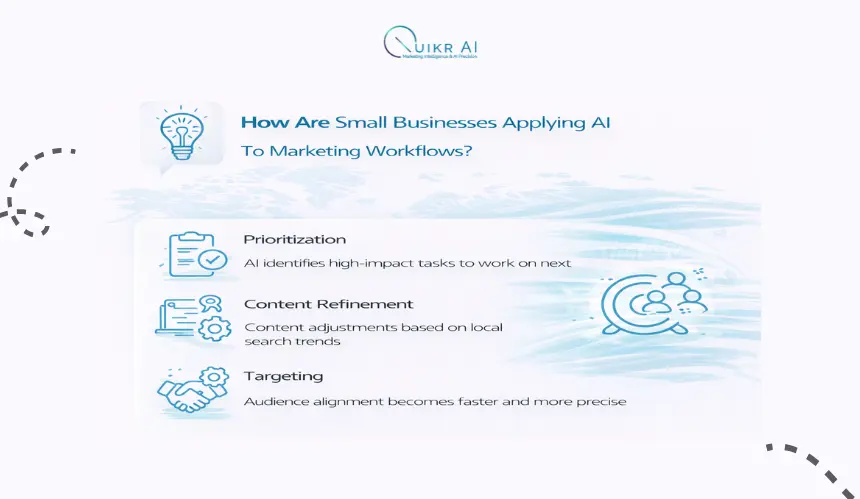
Small businesses are integrating AI into everyday marketing workflows to reduce guesswork and speed up execution. AI-powered tools are commonly used to analyze search behavior, identify content gaps, and forecast performance based on local intent signals.
These applications help teams prioritize what to work on next, whether it is improving service pages, adjusting messaging, or refining audience targeting. The focus remains on efficiency and accuracy, not automation for its own sake.
Why Is AI SEO Optimization Becoming Relevant At The Local Level?
Local competition in Columbus has made search visibility more nuanced, pushing businesses to move beyond basic keyword usage. AI SEO Optimization helps identify semantic relationships, search patterns, and intent variations that traditional methods often miss.
By using AI-assisted insights, businesses can align content more closely with how people in Columbus search, compare options, and make decisions. This leads to better alignment between content structure, local relevance, and actual user behavior.
How Does AI Support Smarter Marketing Decisions Without Replacing Human Judgment?
AI is used as a decision-support layer rather than a substitute for strategy. Tools assist with trend analysis, performance tracking, and optimization recommendations, but final decisions remain human-led. This balance works well for small teams that need clarity without complexity.
AI reduces time spent on analysis while allowing marketers and business owners to focus on creativity, positioning, and customer experience, which continue to drive long-term differentiation in the local market.
If your business is ready to turn local visibility into measurable growth, Quikr AI helps simplify AI-powered marketing decisions, sharpen search performance, and align strategy with how real customers search and choose. The opportunity is already here. The next move is how you use it.
Frequently Asked Questions
What types of industries in Columbus are seeing the fastest marketing innovation right now?
Service-based businesses, healthcare-adjacent companies, logistics support firms, and hybrid eCommerce brands in Columbus are adopting new marketing approaches the fastest.
These industries face high comparison behavior from customers, which pushes them to invest earlier in visibility, positioning, and measurable digital outreach.
Is Columbus more favorable for testing new marketing ideas than larger metro cities?
Yes. Columbus offers a rare balance of audience size and competitive density. Businesses can test campaigns and messaging at a meaningful scale without the extreme ad costs or saturation found in larger metros, making experimentation more accessible and less risky.
How does Columbus’s startup ecosystem influence marketing trends for small businesses?
The startup ecosystem introduces data-driven thinking and rapid iteration habits that spill over into traditional small businesses. Even non-tech companies adopt testing, analytics, and performance tracking because those practices are normalized across the local business community.
Are consumers more responsive to digital-first marketing strategies?
Consumers show strong engagement with digital-first touchpoints such as local search, reviews, and mobile-friendly content. A younger workforce and a high percentage of digitally fluent residents make online discovery a critical factor in buying decisions.
In fact, 98% of consumers now search online to find information about local businesses, and 80% perform a local business search at least once a week, which highlights how essential online visibility is for service providers today.