ChatGPT Ads and the Future of SERP Control, Attribution, and Brand Trust

Instead of buying clicks or rankings, brands will increasingly compete for presence and influence inside AI-generated answers. This shift changes how visibility is earned, how impact is measured, and how much trust a brand carries when an AI system responds on its behalf.
Reuters and other outlets reported OpenAI cited about 800 million weekly active users as a key reason ads could materially change the monetization landscape.
Conversational AI tools such as ChatGPT are accelerating a move away from traditional search result pages toward answer-led discovery. Users are now asking a question and receiving a synthesized response that feels decisive, helpful, and often final.
This article explores how ChatGPT ads affect control over search visibility, and how brand trust evolves when AI systems act as intermediaries between businesses and customers
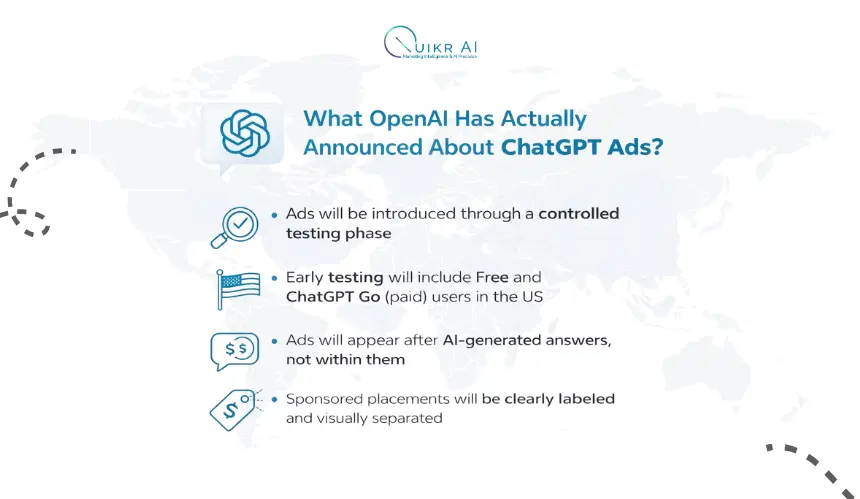
What OpenAI Has Actually Announced About ChatGPT Ads?
OpenAI has shared a limited but concrete set of details outlining how advertising will begin inside ChatGPT. These confirmations establish the boundaries of the rollout and define what brands can realistically prepare for at this stage.
- Ads will be introduced through a controlled testing phase rather than a full public launch
- Early testing will include Free users and ChatGPT Go users in the United States
- The ChatGPT Go plan (the $8-a-month plan tier), previously available in many regions outside the US, is expected to roll out domestically as part of early monetization
- Ads will appear after AI-generated answers, not embedded within the response itself
- Sponsored placements will be clearly labeled and visually separated from organic AI outputs
- Ad exposure will be triggered by conversational relevance rather than keyword matching
- Ads will be excluded from sensitive or regulated topics such as health, politics, and similar high-risk categories
Important OpenAI says it will test ads “at the bottom of answers” only when there is a “relevant sponsored product or service” based on the current conversation, with ads clearly labeled and separated from the organic answer.
“relevant sponsored product or service” based on the current conversation, with ads clearly labeled and separated from the organic answer.
What Has Not Been Confirmed or Disclosed by Open AI Yet?
While the rollout framework is defined, many operational and commercial details remain intentionally undisclosed. These gaps are critical because they limit assumptions about performance, scalability, and competitive dynamics.
- No pricing models, cost structures, or payment frameworks have been announced
- There is no information on auction mechanics, bidding systems, or placement limits
- Targeting controls and advertiser configuration options have not been detailed
- Measurement, attribution, and ROI reporting methods have not been specified
- OpenAI has framed this as a US-focused test rather than an official global launch
- Interactive or conversational ad formats have been suggested but not formally defined or validated
This clear separation between confirmed facts and unresolved details creates a stable foundation for evaluating how ChatGPT ads will reshape SERP control, attribution models, and brand trust in the sections that follow.
From Blue Links to AI Answers: How SERP Control Is Being Redefined
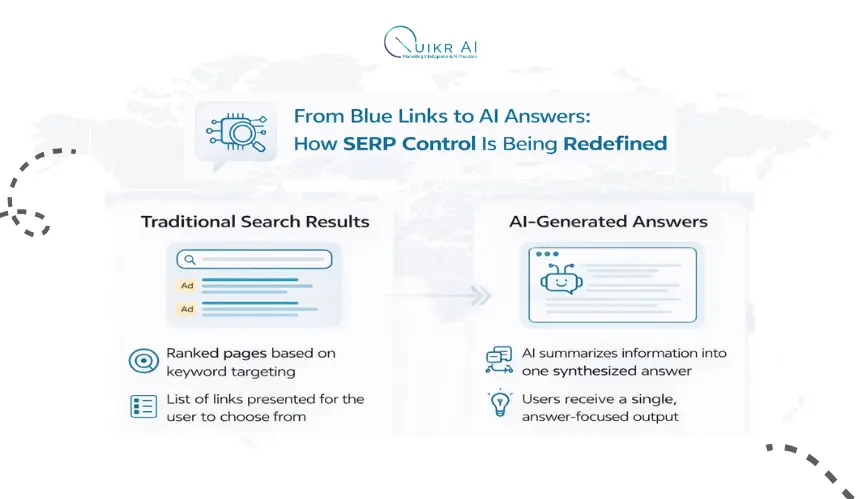
Before advertising, attribution, or trust can be evaluated, it is necessary to understand how control itself is changing inside search and discovery systems. This shift is not caused by ads. It is caused by the replacement of ranked result pages with AI-generated answers that collapse discovery, evaluation, and recommendation into a single interface.
How SERP Control Traditionally Worked in Search Ecosystems
In classic search engines such as Google, visibility followed a predictable structure. Pages competed for rankings based on relevance, authority signals, and technical optimization, while paid listings occupied clearly defined slots. Brands could influence outcomes through keyword targeting, link acquisition, bid strategy, and landing page alignment.
This system gave marketers a high degree of mechanical clarity. Rankings could be tracked. Positions could be defended. Paid visibility could be scaled with budget. Even when volatility existed, control was rooted in identifiable levers tied to pages, queries, and placements.
Importantly, users were presented with options. Control was exercised by being chosen among alternatives rather than by shaping the answer itself.
Why AI Answers Remove Direct Control Over Placement
Conversational AI systems do not present choices in the same way. Instead of listing sources, they interpret intent and generate a synthesized response designed to feel complete. In this model, there is no fixed position to rank into and no guaranteed slot to occupy.
Control over placement is replaced by influence over inclusion. A brand may be referenced, summarized, or excluded based on how the AI system understands the topic, the entities involved, and the relationships between them. This understanding is shaped by training data, retrieval signals, and semantic consistency rather than by page-level optimization alone.
As a result, visibility becomes probabilistic. Brands are no longer competing for a spot on a page. They are competing to be recognized as relevant and trustworthy enough to be part of the answer.
Did you know? Search Engine Land reported that in March 2025, 40.3% of US Google searchers clicked an organic result, down from 44.2% a year earlier, while “zero-click” outcomes increased.
What SERP Control Means When Answers Replace Result Pages
When answers replace result pages, control shifts upstream. The primary challenge is no longer earning a click. It is shaping how an AI system conceptualizes a category, frames a solution, and selects which entities belong in its response.
This redefinition changes the strategic objective. Instead of optimizing for rankings, brands must optimize for comprehension. Instead of defending positions, they must reinforce associations. Visibility becomes a function of semantic clarity and perceived authority rather than mechanical placement.
This shift lays the groundwork for the next sections. Once control is no longer tied to rankings or slots, attribution behaves differently, and brand trust carries more weight.
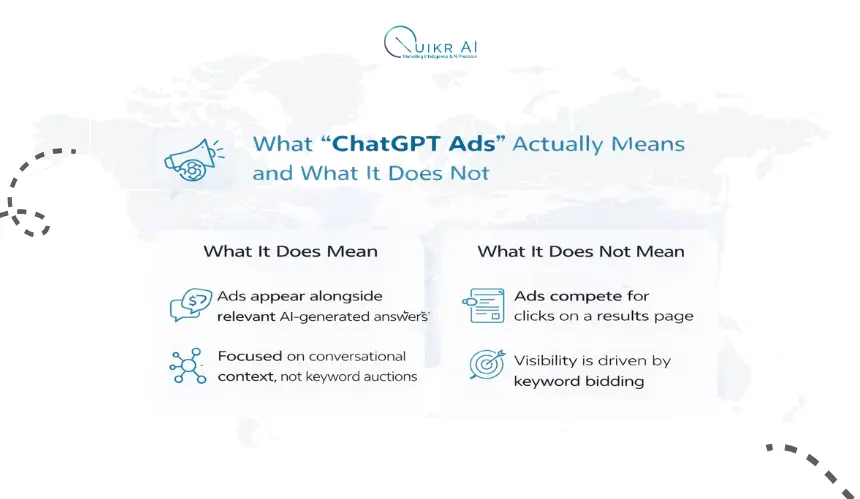
What “ChatGPT Ads” Actually Means and What It Does Not
With the rollout context established and SERP control already reframed, the next step is definitional clarity. Many assumptions around ChatGPT ads come from applying search-era advertising logic to a fundamentally different interface.
How ChatGPT Ads Differ From Traditional Search Advertising
ChatGPT ads are not designed to compete for clicks on a results page. They exist within a conversational environment where the primary interaction is an answer, not a list of options. As a result, advertising operates alongside intent resolution rather than preceding it.
In practical terms, this means ads are not optimized around keyword auctions, impression volume, or position-based visibility. Their relevance is determined by conversational context, topic continuity, and inferred user intent across multiple turns. The advertising unit is not a destination. It is a contextual suggestion that appears after the system has already attempted to satisfy the user’s question.
This distinction matters because it breaks the direct relationship between ad exposure and immediate action. Visibility is no longer tied to interruption or prominence. It is tied to alignment with the ongoing conversation and the problem the user is actively trying to solve.
Why ChatGPT Ads Are Not Just “Search Ads in a New Format”
Treating ChatGPT ads as a reformatted version of search advertising leads to flawed expectations. Search ads are designed for comparison-driven behavior, where users evaluate multiple options and decide where to click. Conversational AI environments collapse that comparison phase by presenting a synthesized perspective first.
In this context, ads do not function as competitive alternatives. They function as extensions of the answer experience. Their effectiveness depends less on persuasive copy and more on perceived usefulness within the flow of the interaction.
Another key difference is narrative control. In search advertising, brands control their messaging within the ad unit. In conversational environments, that message exists adjacent to an AI-generated response that frames the topic, sets expectations, and influences interpretation. The ad does not define the narrative. It inherits one.
ChatGPT ads are not a replacement for search ads. They represent a different class of advertising shaped by conversational context, interpretive systems, and answer-first discovery.
Why Click-Based Attribution Fails in Conversational Interfaces
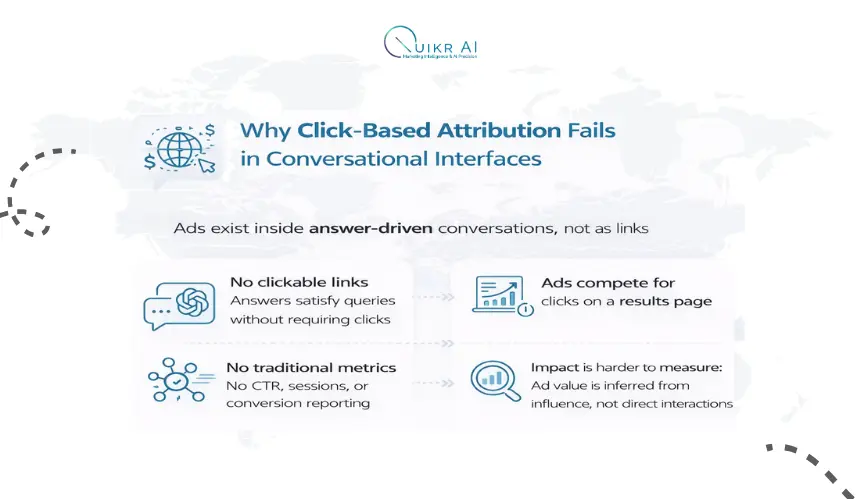
Traditional attribution models assume a linear path. A user sees an ad, clicks, lands on a page, and converts. Conversational AI disrupts that sequence by removing the click as a required step. Users often receive enough guidance from an AI response to act later, elsewhere, or without returning to the source at all.
In an answer-first interface, exposure does not guarantee interaction. A brand can influence a decision without generating a session, a referral, or a trackable event.
This breaks the dependency on familiar signals such as click-through rate, session duration, or conversion paths captured in tools like Google Analytics.
The result is attribution blindness. Influence exists, but it is not captured by systems designed to measure traffic rather than persuasion.
How Influence Replaces Interaction as the Primary Signal
In conversational environments, attribution shifts from interaction-based metrics to influence-based outcomes. The relevant question is no longer “Did the user click?” but “Did the AI response shape the user’s decision?”
This influence may surface as:
- A later branded search
- A direct visit with no referrer
- An offline action triggered by prior guidance
- A preference formed without immediate execution
None of these behaviors map cleanly to traditional attribution frameworks. They resemble recommendation-driven behavior more than performance advertising, which complicates deterministic measurement.
This shift also changes optimization logic. Advertisers cannot rely on rapid feedback loops. Instead, impact is inferred through secondary signals such as brand recall, downstream behavior patterns, and aggregate demand movement.
Why Attribution Becomes Strategic Rather Than Tactical
As attribution becomes less precise, it becomes more strategic. Measurement moves away from granular event tracking and toward directional indicators that suggest influence over time rather than immediate return.
Attribution in ChatGPT ads is not broken because of poor tooling. It is broken because the environment prioritizes answers over actions. This reality sets the stage for why brand trust becomes a central performance variable in AI-mediated advertising.
Who Controls the Narrative in AI-Mediated Discovery: Platforms, Models, or Brands?
As conversational AI becomes an intermediary between users and brands, control over messaging shifts away from individual placements and toward system-level interpretation. This does not mean brands lose all influence, but it does mean influence is indirect and cumulative rather than immediate and transactional.
In AI-mediated environments, the narrative is shaped by how platforms such as OpenAI design retrieval, weighting, and response generation. Brands do not dictate how they are presented in answers. They contribute signals that the model evaluates alongside many others.
Control exists, but it is exercised through consistency, authority, and contextual relevance rather than through direct ownership of space.
This creates a new hierarchy. Platforms govern response logic. Models synthesize meaning. Brands compete to be understood accurately within that synthesis.
Did you know:Pew Research found 61% of Americans want more control over how AI is used in their lives, which raises the stakes for how AI systems represent brands and commercial suggestions.
The balance of power shifts from who pays the most or ranks highest to who is most semantically credible when the answer is formed.
How Companies Can Prepare for ChatGPT Ads and AI-Driven Discovery
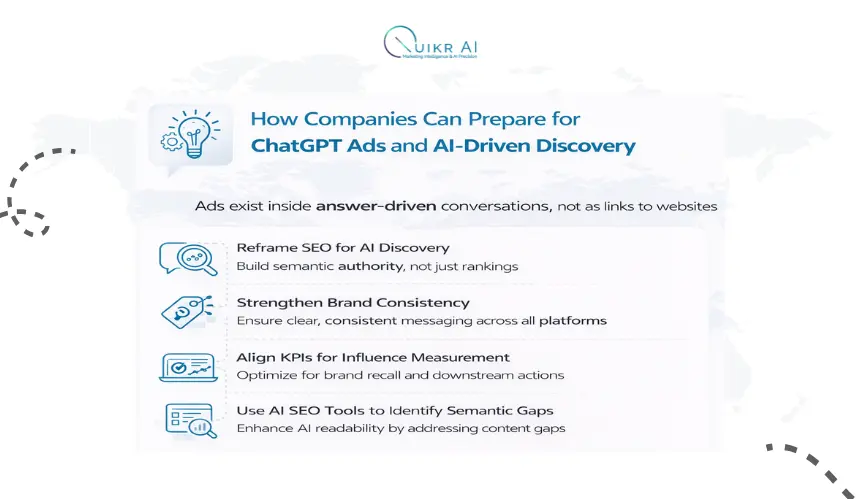
Preparing for ChatGPT ads requires a shift in mindset. The goal is no longer to optimize for exposure alone, but to ensure that AI systems can accurately interpret, recall, and represent a brand within conversational answers. T
his preparation happens before ads are even evaluated.
Companies that prepare effectively treat AI-powered discovery as an extension of their brand infrastructure, not as a new media channel.
Reframing SEO Around AI Interpretation Rather Than Rankings
AI-powered SEO optimization focuses on helping machines understand meaning, not just match queries. Instead of optimizing isolated pages, companies must optimize how their brand and offerings are understood across an entire topic space.
This includes reinforcing clear entity definitions, eliminating contradictory messaging, and ensuring that products and services are described consistently across authoritative sources. When AI systems encounter ambiguity, they hesitate. When they encounter clarity, they include.
Building Semantic Authority Across Core Topic Areas
Brands should prioritize depth over breadth. Covering fewer topics comprehensively creates stronger semantic signals than publishing many shallow pages. AI systems favor sources that demonstrate complete understanding of a subject, not fragmented coverage.
This approach strengthens inclusion probability by reinforcing that the brand is not just relevant, but authoritative within a defined context.
Aligning Measurement With Influence-Based Outcomes
Preparation also requires adjusting expectations around performance measurement. Clicks and direct conversions will not fully reflect impact in conversational environments. Companies should begin aligning teams around broader indicators such as branded demand, recall, and downstream behavior trends.
This alignment prevents misjudging conversational exposure as underperforming simply because it does not produce immediate, trackable actions.
Using AI-Powered SEO Tools to Identify Gaps and Inconsistencies
AI-powered SEO optimization can analyze how brands are represented across large content ecosystems, identify missing semantic associations, and surface inconsistencies that weaken AI interpretation. These tools help teams move from reactive optimization to proactive readiness.
By addressing gaps before conversational ads scale, companies position themselves to benefit from AI-mediated discovery rather than struggle against it.
Preparing for Ads by Strengthening the Foundation First
ChatGPT ads will reward brands that are already understood. Advertising will amplify existing signals, not compensate for weak ones. Companies that invest now in semantic clarity, entity authority, and AI-readable content structures will be better positioned as conversational advertising evolves.
Preparation is not about mastering a new ad format. It is about becoming legible, trustworthy, and contextually relevant to AI systems that increasingly shape how decisions are made.
As conversational AI reshapes how decisions are made, brands that wait risk becoming invisible inside AI-generated answers. Quikr AI helps businesses prepare for this shift by strengthening semantic authority, AI-readable content, and future-ready SEO strategies. If you want your brand to be understood, trusted, and surfaced in AI-driven discovery, now is the time to act.
Frequently Asked Questions
How will ChatGPT ads affect smaller or emerging brands compared to large enterprises?
ChatGPT ads are likely to change competitive dynamics rather than reinforce existing dominance. Large brands benefit from widespread recognition, but conversational AI systems also reward clarity, specificity, and relevance.
Smaller brands with well-defined offerings and strong topical focus may surface more often in niche or intent-rich conversations where enterprise brands are less contextually aligned.
Will ChatGPT ads influence buying decisions even if users do not click anything?
Conversational AI can influence decisions upstream by shaping how users think about options, tradeoffs, and categories. Even without direct interaction, exposure within an AI-generated answer may guide preferences, reduce uncertainty, and frame later choices. This influence often appears through delayed or indirect actions rather than immediate engagement.
Can brands control how they are described in ChatGPT responses?
Brands cannot directly control wording or presentation inside AI-generated answers. However, they can influence accuracy and consistency by ensuring that authoritative, current information about their offerings is widely available and semantically consistent across trusted sources, reducing the risk of misinterpretation over time.
Will ChatGPT ads replace traditional search advertising?
ChatGPT ads are unlikely to replace search advertising in the near term. Instead, they introduce a complementary discovery channel that operates earlier in the decision process.
Search ads continue to capture existing demand, while conversational ads shape awareness and consideration before demand is fully formed.
How should companies think about budgeting for ChatGPT ads without clear ROI metrics?
Early budgeting decisions are best approached as controlled experimentation rather than performance optimization. Initial investment should prioritize learning, exposure, and insight generation. As measurement frameworks mature, spending strategies can evolve toward more outcome-driven evaluation.
What skills will marketing teams need as conversational ads become more common?
Marketing teams will need stronger collaboration across SEO, content, brand, and analytics functions. Skills related to semantic optimization, AI content evaluation, entity understanding, and qualitative performance analysis will become increasingly important as conversational interfaces influence discovery and decision-making.