How Columbus Customer Behavior Is Changing (& How to Market to Them)

Over the past few years, Columbus has quietly become one of the fastest-evolving consumer markets in the Midwest. With a steady influx of young professionals, a growing startup ecosystem, and one of the largest university populations in the country, buying behavior here is changing faster than many businesses realize.
Business success in Columbus now depends on understanding how people in Columbus discover options, evaluate credibility, and decide when a brand feels worth engaging with. Understanding these patterns is the starting point for marketing that actually connects.
What Is Driving the Shift in Customer Behavior Across Columbus?
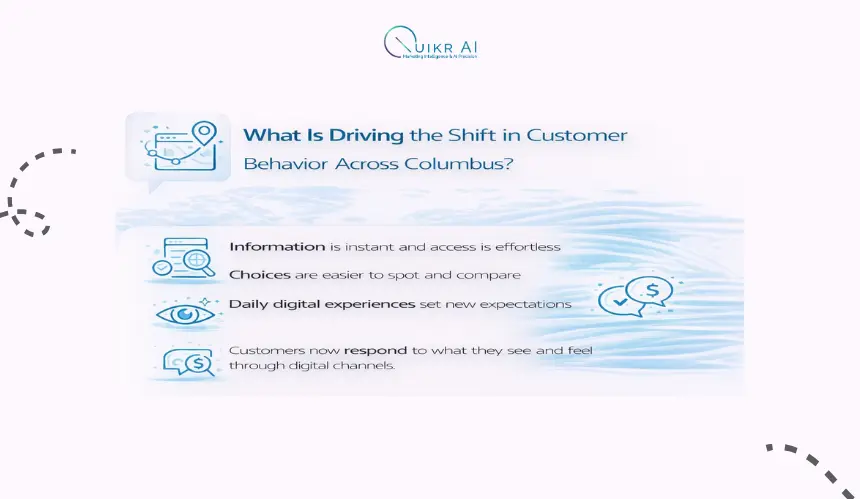
Customer behavior in Columbus is changing because the environment people make decisions has changed. Access to information is faster, choices are more visible, and expectations are shaped by daily digital experiences rather than brand promises.
Local customers are no longer reacting only to advertising. They are responding to economic signals, lifestyle adjustments, and how smoothly a business fits into their decision process.
Did you know? Columbus added 12,694 residents from 2023 to 2024, reaching an estimated 933,263 people. That kind of steady growth changes buyer expectations because “new residents bring new baselines” for service, speed, and brand experience.
How Economic Awareness is Shaping Value-Focused Decisions
Rising living costs and greater financial awareness have made consumers more deliberate with spending. Purchases are evaluated through perceived long-term value rather than immediate appeal. Customers compare options carefully, look for justification beyond price, and gravitate toward businesses that communicate clarity around what they offer and why it matters.
This shift has increased sensitivity to hidden costs, unclear pricing, and vague value propositions. Marketing that highlights outcomes, transparency, and practical benefits resonates more strongly than promotional language that focuses only on discounts or urgency.
Why Digital-First Research Now Happens Before any Brand Contact
Search behavior plays a central role in how Columbus customers form opinions. Before calling, visiting, or submitting a form, most people research independently. They read reviews, compare service pages, scan local listings, and evaluate how well a business explains its process.
This research phase shapes expectations long before a conversation begins. Brands that provide clear, informative content during this stage feel more credible and easier to trust. Those with limited or outdated digital presence often get filtered out without direct interaction.
Interesting:BrightLocal’s Local Consumer Review Survey found that 98% of consumers at least occasionally read online reviews for local businesses when they’re deciding where to spend.
How Lifestyle Changes Influence Convenience and Engagement Timing
Columbus is still a commuter-heavy city. The U.S. Census reports the mean travel time to work is 21.8 minutes (2019–2023), which reinforces why customers value fast replies and low-friction scheduling around busy weekday routines.
Work flexibility, mobile usage, and time constraints have reshaped when and how people engage with businesses. Columbus customers often interact outside traditional hours, prefer low-effort communication, and expect responses that respect their time.
How Buying Journeys Have Become Non-Linear
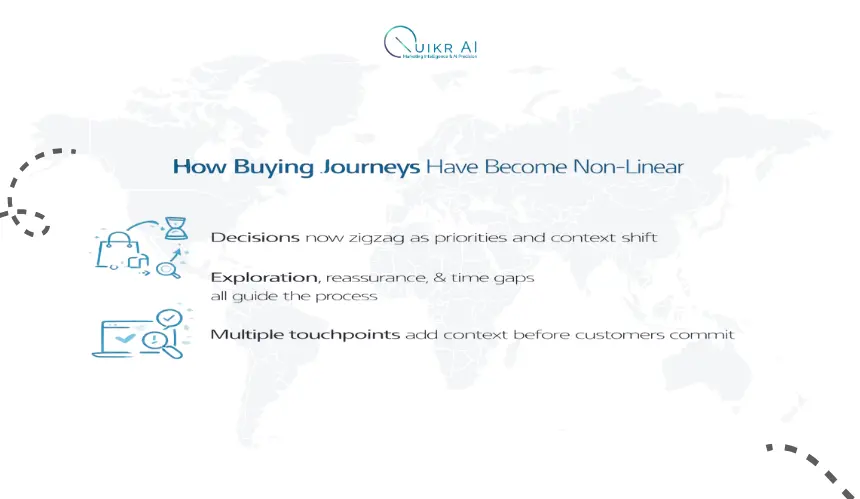
Modern buying decisions rarely follow a straight path. Customers move in and out of consideration as new information appears, priorities shift, and daily life interrupts the process.
A product or service may be researched briefly, set aside, and revisited later after additional context or reassurance is found. This pattern reflects how much control customers now have over when and how they engage.
Non-linear journeys are not driven by confusion or hesitation alone. They are the result of choice abundance and easy access to information. Customers prefer to progress at their own pace, gathering confidence through repeated exposure.
Customers Now Rely on Multiple Touchpoints Before Committing
Interesting Information: Google’s “messy middle” research frames modern buying as a loop where people cycle between exploration and evaluation until they feel confident enough to commit.
Most buyers no longer trust one source of information to guide a decision. Search results, review platforms, websites, and third-party mentions each play a different role in shaping perception. One touchpoint may introduce the brand, while another confirms credibility or clarifies details that were not immediately obvious.
This layered evaluation helps reduce perceived risk. Instead of relying on a single impression, customers build confidence through consistency across channels.
In growing markets like Columbus, where options are visible and competition is active, this behavior becomes even more pronounced as customers compare familiar names against newer alternatives.
Content Consumption Replaces Early Stage Conversations
Interesting:Omnichannel behavior is now mainstream. A Harvard Business Review study of 46,000 shoppers found 73% used multiple channels during their shopping experience.
Early conversations that once happened over the phone or in person are now happening through content. Customers increasingly expect to find answers without asking, using service pages, FAQs, and explanatory resources to self-educate before reaching out. This allows them to filter options quietly and avoid unnecessary back-and-forth.
Content now acts as a decision support system rather than a sales tool. When information feels specific, current, and useful, it builds confidence and shortens the path to engagement. When it feels thin or unclear, customers often pause their journey and continue exploring elsewhere.
Decisions Stretch Over Time Instead of Happening Immediately
The ability to pause and return has changed how quickly decisions are made. Customers know they can step away, compare alternatives, and revisit options without losing access or opportunity. As a result, many decisions unfold over days or weeks rather than moments.
This extended timeline does not signal disinterest. It reflects deliberate evaluation. In cities experiencing steady growth and market expansion, such as Columbus, customers are especially likely to revisit a small set of options multiple times before choosing.
Brands that remain visible and consistent during this period feel familiar and trustworthy when the decision point finally arrives.
What These Customer Behavior Shifts Mean for Marketing Strategy
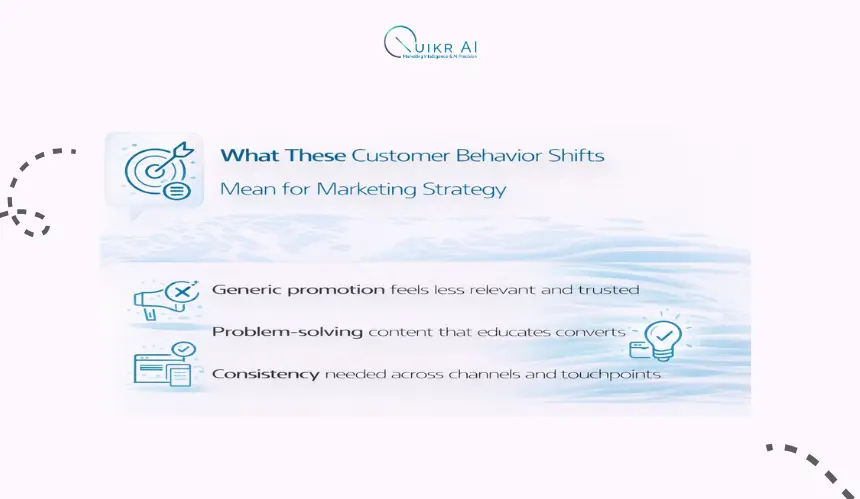
When customer behavior changes, marketing performance changes with it, even if budgets and channels stay the same. What used to work through broad visibility or frequent promotion now often underperforms because it does not match how people research, compare, and build confidence today.
The goal is no longer to “push” a message harder. It is to reduce uncertainty, make the brand easier to trust, and stay present across the moments that influence the decision.
Why Generic Marketing is Losing Influence in Today’s Columbus Market
Columbus is widely used as a “test market” for national brands, because it’s often described as a microcosm of broader U.S. consumer demographics. That reality means customers see a constant stream of new offers and messaging, so generic copy gets filtered faster.
Generic marketing struggles because customers have become better at filtering. When messaging feels broad, it gets interpreted as less credible and less worth attention. People now want signals that a business understands the specific problem, the expected outcome, and what the experience will feel like, not just what service is being offered.
This shift does not require complex personalization to address. It requires clarity and focus. Working with an expert SEO company in Columbus can help businesses identify the search patterns, intent signals, and language cues that local customers respond to, allowing marketing to feel relevant instead of interchangeable.
How the Shift From Promotion to Problem-Solving Changes What Converts
Modern customers respond to marketing that helps them make a decision, not marketing that simply tries to trigger one. That is why educational, problem-solving content has become a conversion asset. It answers pre-purchase questions, sets expectations, and reduces the fear of making a wrong choice.
This shift also changes what “strong” messaging looks like. Instead of leading with urgency, the strongest campaigns often lead with clarity, proof, and a clear path forward. When people feel informed, they are more likely to engage, because the next step feels safe rather than risky.
Importance of Consistency Across Channels in Modern Marketing
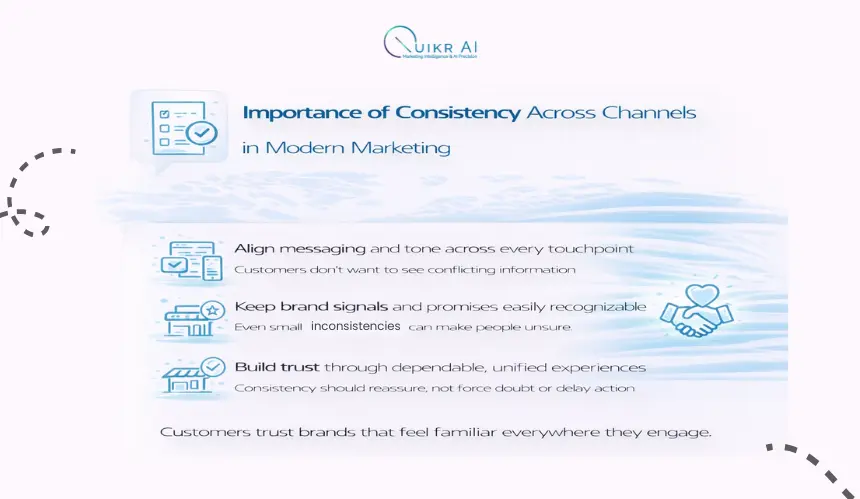
Important:Demand Metric found that organizations struggling with inconsistent brand presentation estimate an average 23% revenue lift when messaging, positioning, and brand signals are aligned across channels.
Because customer journeys are non-linear, customers will often meet a brand in more than one place before they act. If messaging, tone, and information change from platform to platform, it creates doubt. Even small inconsistencies can trigger hesitation because they raise questions about reliability.
Consistency is not about repeating the same line everywhere. It is about aligning the promise, the evidence, and the next step across every touchpoint. When a brand feels coherent, customers do not have to work to understand it.
That smoothness builds trust, keeps the brand in the shortlist, and makes engagement feel like a natural decision instead of a gamble.
How to Adapt Marketing Efforts to Match Columbus Customer Expectations
Adapting marketing in a modern local market is less about adding more tactics and more about mirroring how customers already behave. People search first, compare fast, and move forward only when information feels relevant and trustworthy.
Strategy comes before execution here. When content is built around real intent patterns, every channel performs better because the message matches the moment the customer is in.
Step 1: Map the Real Intent Behind Your Highest-Value Queries
List the searches you want to win, then label each one by intent: informational, comparison, transactional, or “near-me” local intent. The goal is to stop treating all keywords the same and start building content around the decision stage.
This is where intent mapping becomes practical, because it tells you what the searcher is trying to accomplish, not just what they typed.
Step 2: Group Keywords Into Intent Clusters Instead of Writing Isolated Pages
Create clusters that reflect how people research. One cluster might be “cost and pricing questions,” another might be “best option comparisons,” and another might be “process and timeline concerns.”
This improves search intent optimization because the content starts answering related questions in one place, rather than scattering answers across thin pages that compete with each other.
Step 3: Build One Primary Page Per Cluster, then Support It With Sub-Pages Only When Needed
Start with one strong page that addresses the core query and its close variants. Add supporting pages only if the topic truly needs separate depth, such as a detailed pricing breakdown or a full comparison guide. This prevents content overlap and keeps your site structure clean, which improves content relevance and makes internal linking more logical.
Step 4: Match Page Structure to Search Scanning Behavior
Write about the scanning behavior seen in search today. Use clear sections, direct phrasing, and short “answer-first” sentences before expanding. If a searcher wants “how it works,” the first lines should explain the process.
If they want “which option is better,” the first lines should define the comparison criteria. This query-based alignment increases engagement because it reduces the time it takes for a reader to feel they found the right page.
Step 5: Add Proof and Clarity Where Hesitation Naturally Occurs
Identify the points where people pause, such as pricing uncertainty, timeline concerns, trust risks, or confusion about what is included. Then add clarity exactly there, through examples, simple explanations, and expectations. This makes the content feel like it was written for real decision-making, not just for ranking.
Step 6: Validate Intent Match Using Search and On-Page Signals
Use Google Search Console to see which queries are bringing impressions and clicks, and compare that with bounce rate, time on page, and conversion behavior. If a page ranks but does not convert, it often means the intent match is off. Adjust headings, opening lines, and section order until the content aligns with what the searcher wanted to know.
Step 7: Refresh Content Through Targeted Updates, Not Full Rewrites
Instead of rewriting everything, update the parts that lose trust first: outdated references, unclear offerings, missing FAQs, and vague sections. Regular “freshness” improvements keep relevance strong and help the content stay aligned with evolving search behavior without creating repetition.
Understanding how customer behavior is shifting is only valuable when it turns into smarter action. If your marketing feels visible but not effective, it may be time to realign how your brand connects with real intent. Quikr AI helps businesses translate customer behavior into clear, conversion-focused strategies that feel relevant at every touchpoint.
When marketing mirrors how people actually search, evaluate, and decide, growth becomes consistent instead of unpredictable.
Frequently Asked Questions
How often should businesses reassess customer behavior trends?
Customer behavior should be reviewed on a rolling basis rather than annually. Search patterns, engagement signals, and conversion behavior can shift within months due to economic changes, platform updates, or local market activity. Regular quarterly reviews help businesses stay aligned without overreacting to short-term noise.
Do customer behavior changes affect small businesses differently from large brands?
Yes, smaller businesses often feel these shifts faster. Limited budgets make inefficiencies more visible, but smaller teams can also adapt messaging, content, and positioning more quickly. This flexibility allows small businesses to realign faster when they pay close attention to behavioral signals.
How can businesses identify early signs that their marketing no longer resonates?
Early indicators usually appear in engagement metrics rather than traffic numbers. Rising bounce rates, shorter time on page, fewer return visitors, and stalled conversions often signal that messaging no longer matches expectations, even if visibility remains stable.
Is paid advertising still effective when customer journeys are more complex?
Paid advertising still plays a role, but its function has changed. Instead of driving immediate decisions, it often supports awareness and re-engagement across longer journeys. Ads perform best when they reinforce clarity and trust rather than pushing urgency too early.
How do algorithm changes impact customer decision-making behavior?
Algorithm updates influence what information customers see first, which shapes trust and perception. When search results prioritize clarity, authority, and relevance, customers naturally adopt higher expectations. Businesses that track these shifts can adjust content before performance declines.
Can customer behavior insights improve retention, not just acquisition?
Absolutely. Understanding how customers think after the purchase helps improve onboarding, communication timing, and follow-up messaging. When post-purchase experiences align with expectations set during research, retention and referrals increase naturally.